Monday, 8 February 2016

What Does Jesus' Death Mean To A Non-Literalist?

I'm asking myself, "what does Jesus' death mean to me?" Because, I don't have it all figured out, and maybe I can sort through it in this post.  I do know that I'm uncomfortable with a substitutionary sacrifice and atonement theology that leans towards literalism.  I also wonder what these same doctrines would look like if given a broader, more metaphorical and symbolic view.

I try to approach religion following the maxim attributed to George Box about science:

Essentially, all models are wrong, but some are useful.
Our theologies and metaphors in Scripture are only models and not the thing itself. Or as Paul puts it, "For now we see only a reflection as in a mirror; then we shall see face to face. Now I know in part; then I shall know fully, even as I am fully known." (1 Cor. 13:12)

With that in mind, there is much about a more literal interpretation of sacrifice and substitutionary atonement that I find uncomfortable and not in keeping with Jesus' actual teaching.  It implies that God is a petty and unforgiving legalist and that God's main relationship with humanity involves a broken contract where all our lives are forfeit and can not be waived without a, "pound of flesh", in terms that must be paid for with a death.  This model portrays a remorseless, unrelenting God tied to a legal system he or she is unable or unwilling to forego.  This is in complete contrast to the God that Jesus characterized as primarily loving, compassionate, and forgiving.  This is not the king in Jesus' parables that forgives all his servant's debt, or the landowner who pays the workers who only put in a few hours the same as those who had worked all day.


Jesus did not come to change the mind of God about humanity; Jesus came to change the mind of humanity about God. 
Franciscan saying
In the article from the Franciscan Centre for Action and Contemplation linked below, Richard Rohr points out how the Franciscan Christian Tradition has for one, "never believed that 'blood atonement' was required for God to love us." 
The substitutionary atonement “theory” (and that’s all it is) seems to imply that the Eternal Christ’s epiphany in Jesus is a mere afterthought when the first plan did not work out.  (Richard Rohr)
https://cac.org/incarnation-instead-of-atonement-2016-02-12/

Many early and primitive religions around the world share the concept of blood sacrifice.  This idea views calamity and misfortune as coming from God or the gods as either punishment or just as a result of the gods' capricious and destructive nature.  Famine, disease, floods, and personal misfortune, are due to the violent nature of gods who are only satisfied by death and destruction.  Sacrifice was a way to try to divert the gods' wrath away from oneself by providing an alternate target. Killing a sacrificial animal was an attempt to appease the gods' blood lust so that you and your community might be left alone.

In the third chapter of the Gospel of Luke, Jesus dismissed the notion of disaster and calamity as punishment from God.
Now there were some present at that time who told Jesus about the Galileans whose blood Pilate had mixed with their sacrifices. Jesus answered, “Do you think that these Galileans were worse sinners than all the other Galileans because they suffered this way? I tell you, no! ... Or those eighteen who died when the tower in Siloam fell on them—do you think they were more guilty than all the others living in Jerusalem? I tell you, no!”
Ritual killing was also tied into the Hebrews' model for their relationship with God as being a covenant of the type that some neighboring nations had with their king, or which potentially hostile parties of the time created to keep the peace and form a basis for cooperation.  These contracts usually had a literal, "cross my heart and hope to die", aspect. Animals were usually killed as part of the swearing ceremony in order to symbolize that breach of the contract would result in violence and death similar to what was being inflicted on the animals.
 
After Israel established itself as a nation and built a Temple for their God, animal sacrifice started happening on an industrial scale in a way meant to enrich and boost the theocracy of the Temple establishment. It became a monopoly on a transactional relationship between the people of Israel and God.  

As part of the renewal of the Covenant with Moses, the Law had been introduced as a concession because the people were unable to bear the direct presence of God in order to follow his ways in spirit. As part of this renewed contract, with the Law as the terms and conditions, a penalty mechanism was given. If someone breached the contract by breaking the law, all could be made right by making an animal sacrifice payment as a substitute for one's own life. The penalty for breaking some laws was the death of a pigeon or dove, while other laws required larger animals like sheep. This was big profit for those connected with the Temple business. Part of Jesus' cleansing of the Temple was a response to the exploitation of the rural poor where they were forced to purchase animals at the Temple rather than bring their own.

The law in Temple Judaism was pretty clear and was a finite list, making the "sin" requiring sacrifice pretty specific.  Early Christian writers, however, broadened the definition to make it pervasive and non-specific.  We were all now culpable for original sin and were all universally sinners.  Basing their ideas on Paul's statement that, "all have sinned and fallen short of the glory of God", the concept of mankind as universal sinners and Jesus' death as payment in liue of punishment in hell, gave meaning and importance to Jesus' execution.  The defeat and humiliating torture and death of their religion's founder needed to be justified in heroic terms.  The worse and more horrific the punishment borrowed from the Greek myths of Hades that Jesus needed to rescue us from, the more significance and honour in Jesus' death.
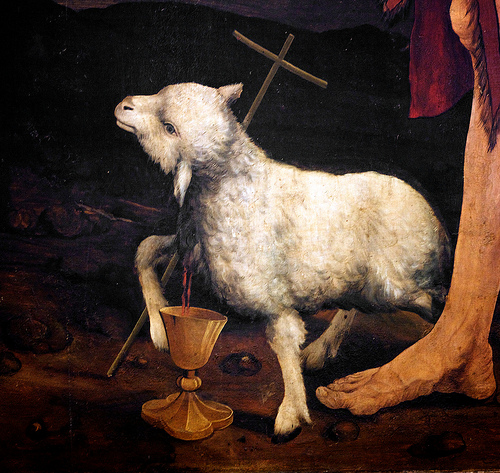
What are we to make of images of sacrifice and substitutionary atonement in the Gospels.  Why was Jesus identified as, "the lamb of God that takes away the sin of the world"?  I think we have to begin with recognizing that Jesus was a Jewish Rabbi and wisdom teacher and like many of that tradition he used existing stories and myths that his listeners knew and gave them his own twist in order to illustrate a point or different perspective.  This does not mean that he endorsed the truth or factuality of the original stories himself.  He used stories that included the Egyptian and Greek myths of an afterlife.  He also told what we believe were original stories and parables where he turned the outcome expected by his listeners upside down.  It makes sense that the Gospel writers would use the same techniques in their stories about Jesus himself.  They told the stories weaving in the ideas about sacrifice and atonement that their audience knew, and like Jesus, they turned those ideas upside down and replaced the expected with the unexpected.

One also needs to put the writings of the Gospels in context of the history of the time.  The Gospels were written right after the destruction of the temple while Judaism was struggling with how to remain faithful to the Covenant when the Temple practices of sacrifice were no longer possible.  Many streams of Judaism were vying as having the legitimate successor to those practices.

A major portion of Temple Judaism revolved around an ethos of ritual purity and holiness.  The fledgling sect of the Way of Jesus was somewhat suspect in this regard. This group favoured the inclusion of uncircumcised gentiles and women, and spurned dietary laws and other purity practices in favour of broader principles of justice and compassion.  In order to counter this and to make Christianity a viable continuation of Judaism, they told the story of Jesus in a way that made both the rigid adherence to the purity laws and continual Temple sacrifice as no longer necessary.  The death of Jesus became the story of a new Covenant with God with extraordinary steps that made the existing contract complete and fulfilled

So, what would a non-literalist interpretation of this look like? A non-literalist view recognizes anthropomorphic images of God as a sentient being as metaphor. The concept of "God" is how we express what we find as legitimate, true, and worthy. We who follow the Christian tradition, affirm Jesus' vision of God as primarily loving, compassionate, and generous. God is the portrayal of these abstract qualities in a human like form.

Let's look at the narrative of Covenant, atonement, sacrifice, and Jesus' death through that perspective. The story of Covenant tells us that humankind has a contract with God, with the qualities of love, compassion, generosity, justice, and forgiveness (to name a few). Where we are able to live by these qualities, we experience fullness of life, protection from harm, and unity. We try to craft rules and laws based on these qualities and impose them on our communities to dictate our behavior along these lines. However, we can not rely on these laws where these qualities have not been internalized to the point that they are the source of our actions. We constantly fall short of these qualities, and the result is "death" in contrast to "life" in the form of violence, cruelty, exploitation, alienation, disunity, un-forgiveness, greed, and many other negative results. These failures in meeting the requirements of our "contract with God" have natural consequences and requires great payment in order for humanity to fulfill our side of the contract and in order to regain the benefits that this contract promises. To counter our breach of contract sometimes requires great sacrifice.

This is where I see Jesus and his death as coming in. Jesus was a person who lived in a land that had been defeated and was occupied by a foreign empire that ruled and exploited the people through trade and taxation enforced through violence and military power. The ideology of Empire was that "might made right". The ones with power defined what was legitimate, what was of God, and their vision of God authorized and laundered their violence and greed by depicting their wealth and power as the rewards and affirmation of their god or gods.

Jesus comes on this scene spreading a subversive message that was the antithesis of the ideology of Empire. His vision of God was one where love, generosity, and compassion are what is legitimate and true. He taught that we should love others as we love ourselves, including our enemies, and do good to those who seek to harm us. He called out the religious authorities on their exploitation and exclusion of the poor and powerless. As a result, he was seen as a threat to their rule and the fragile relationship they held with their oppressors that allowed them to continue to hold power over the people. As such, he was sentenced to death. Even in the face of this, he held firm to his covenant with a God of peace and unbridled love, not resisting arrest and forbidding his followers to defend him with violence. He was willing to let his life be payment for the cruelty and self-interest of others, a sacrifice of love and peace over violence and hatred. By submitting to the violence of others instead of responding in kind, he showed us how to pay what is needed to bring the Covenant to fulfillment, and settle the balance by breaking the cycle of hate and violence. The "payment" of suffering violence without retaliation works to help erase the attitudes of violence and cruelty and heal the scars that grow more hate and bloodshed. "Greater love has no one than this: to lay down one’s life for one’s friends" (John 15:13)...unless it is to lay down one's life for the enemy who would take it, to spare them violence at your own hand or the hand of your tribe as Jesus did. This is the ultimate expression of radical love.
____________________
"Greater love has no one than this: to lay down one’s life for one’s friends"....unless it is to lay down one's life for the enemy who would take it, to spare them violence at your own hand or the hand of your tribe as Jesus did.
____________________

If we literalize the metaphors around Jesus death, we reduce the nature and extent of Jesus' sacrifice.  How much of a self-sacrifice is it to lay down your life if you know that your death is only temporary?  What even moderately decent person would not suffer Jesus' fate if it was the literal means of sparing much of humanity eternal punishment and pain?  How is the offering costly if you know that as a result you will be rewarded with great power and authority?

We also belittle the nature of this offering if we try to glorify it by characterizing it as a display of great machismo, stoicism, and endurance.  The Mel Gibsons of Christianity would have you believe that the more Jesus suffered, the more that it proves his love for you, and that it was a, "good death", worthy of a man's man.  But, the Gospels do not portray it as marked by any special endurance or experience as compared to the many who were executed in this manner by the Roman authorities.  Not to minimalize the experience of anyone killed by crucifixion, but Jesus did not even endure the level of torture of the two criminals he was hung beside.  The Gospels relate the Roman crucifixion practice of breaking the legs of the person hanging on the cross so that all their weight was supported by their arms, leading to a slow agonizing death by suffocation.  Jesus was spared this.  When the Roman soldiers went to break his legs they found that he was already dead.  

Jesus' experience on the cross was a demeaning and belittling spectacle.  For a Jew, particularly a Rabbi, to be displayed in public naked, to be mocked and be held up as an object of ridicule, powerless and vulnerable among criminals, is the height of humiliation.  This humiliation was endured as an expression of a love that would save the world by not being the source of more violence.

The narrative is that the sacrifice of Jesus spares those who believe in him from everlasting suffering and grants them eternal life in a new and fuller relationship with God.  Seen metaphorically, the Way of Jesus, as exemplified and demonstrated by his death, and believed in and practiced by his followers, spares all of humanity much suffering.  It brings life and healing into human relationships and brings humanity into a fuller communion with love, compassion, and generosity.

The Gospel stories portray Jesus as having been raised from the dead and seated at the right hand of God, the ultimate affirmation by the symbol of all that is legitimate.  Jesus continues to live in the hearts and minds of his followers today and his spirit resides in all who choose radical love over violence and self-interest.  

Jesus is Risen.  He is Risen indeed!


Monday, 1 February 2016

Blue-Eyed Fair Haired Nordic Jesus; Pros and Cons


http://www.theblaze.com/wp-content/uploads/2013/01/jesus-496x620.jpg

Probably the best known and most reproduced image of Jesus is the blue-eyed, fair-haired, Aryan Jesus of Sallman Head, titled the, 'Head of Christ'.  Of course, it looks nothing like the way Jesus, a Jewish man living in the First Century Middle East, would have appeared.  It is an appropriation of Jesus in the service of white cultural values.  This has both positive and negative aspects.


http://www.universe-people.com/english/img_0000/obr400.jpg
Let me say a little more about this specific image of Jesus to begin.  This is of course not the only painting of Jesus that forgoes the darker skin and Semitic features one should expect from our reading of the Gospels.  There are plenty of blue-eyed, light-skinned, pretty Jesus paintings out there.  This one, however, has become an almost universal icon.  It has been reproduced over half a billion times worldwide.  It can be found in both Protestant and Catholic churches, can be found in use among Mormons, Latinos, Native Americans, and African Americans, and is widespread across the world in areas including Africa, Latin America, Asia, and Eastern Europe.  There is a copy of this painting both in the basement of the Church I currently attend, and in the Sanctuary of the previous Church I went to.  My grandparents had a print of this painting that hung in their bedroom over their bed.  The painting is said to have "become the basis for [the] visualization of Jesus" for "hundreds of millions" of people (Lippy, Charles H. (1 January 1994). Being Religious, American Style: A History of Popular Religiosity in the United States)

https://en.wikipedia.org/wiki/Head_of_Christ
http://www.warnersallman.com/collection/images/head-of-christ/


http://thumbs.ebaystatic.com/d/l225/m/mJlHVw9-0OpTVW4ONJUS7Ew.jpg
https://thejesusquestion.files.wordpress.com/2011/03/sallman_reproductions.jpg
The, "Head of Christ", was painted by the American artist Sallman Head in 1940.  Sallman was a freelance illustrator who produced religious imagery for a variety of publications.  The Baptist Bookstore picked up the image and distributed lithographs of various sizes in their stores across the Southern United States.  The image was then used on a variety of products; clocks, lamps, buttons, mottoes or Scripture texts, Bibles, and puzzles.  During the Second World War, the Salvation Army and the YMCA, both members of the USO, handed out pocket-sized versions of the picture to American soldiers leaving for Europe and Asia.  After the war, groups in Oklahoma and Indiana conducted broad campaigns to distribute the picture across private and public spheres.  Copies of the painting were placed in public libraries, schools, police departments, community centres, and even in courtrooms.

http://www.christianitytoday.com/ch/2006/issue91/11.11.html

Of course, Jesus would not have looked anything like this.  A recent documentary which had scientists perform a "forensic reconstruction" of Jesus shows a very different face.  The reconstruction was created with a 2,000-year-old Jewish skull, ancient documents, and advanced software and forensic techniques to show a first-century Jewish man who would have lived in the harsh conditions of the time.
"Jesus certainly looked far more like that person than me and other males who live in the West," says James Charlesworth, professor of New Testament languages at Princeton Theological Seminary, one of the experts consulted in the documentary.

So, why has a portrait of Jesus, that we know would look nothing like him, become so popular?   I would suggest that it is for the same reason that Jesus, as a concept of God, is so popular; it makes God relateable.  God is a personification of what we believe is truly legitimate, noble, powerful and worthy,  Anthropomorphizing God allows us to represent these abstract qualities in a human like form that we can relate to and make our own.  The image of Jesus takes that another step.  Visualizing Jesus as looking like someone who is part of our own cultural and ancestral heritage group takes it even one step further.  The Caucasian cultural group was dominant through most of the western world when this image was popularised.  As such, visualizing him as white also conferred legitimacy and authority.

The need to visualize God in an accessible, close to home, way is well expressed in the recent song, "One of Us", written by Eric Bazillian and popularized by Joan Osborne as the theme song for the American television series, "Joan of Arcadia",.

What if God was one of us?
Just a slob like one of us?
Just a stranger on the bus
Trying to make His way home?


This desire to portray Jesus as part of one's own cultural/racial group is not limited to white dominant culture.  Communities of colour and different ethnic heritages also portray Jesus with an appearance similar to their own.  There are many portraits of a black Jesus.  But they are much less prevalent in our society and can even be discouraged as sacrilegious by the dominant christian culture.  I can remember an episode of the Television show, "Good Times", where the eldest son, "JJ", an aspiring ghetto artist, wants to submit a painting of a black Jesus in a local art contest.  His family, who hold a copy of Sallman's white Jesus hanging on their apartment wall in reverence, find this to be scandalous.

https://s-media-cache-ak0.pinimg.com/736x/d7/27/52/d72752c2e16f771ac86fd0f60b374d71.jpg


http://static1.squarespace.com/static/53da8a0fe4b0d5d5360f89d8/t/53f5056ce4b0a1e4bd39bcde/1408566666489/
Similarly, there is current comedy on the Adult Swim segment of the Cartoon Network called, "Black Jesus", that has stirred up a lot of controversy.  However, only part of the objections being voiced involve Jesus being portrayed as being black with a good part involving irreverences.


There are also Oriental representations of Jesus.  Again, these are not nearly as prevalent as Caucasian ones, even in Asian countries.


If you’re interested in seeing more Asian Jesus/Christian art, click here.

So, the 'pro' for having representations of Jesus that mirror your race and culture is that it helps one visualize God as familiar and, "one of us", relateable and personal.  What are the 'cons'?  One drawback is that it makes it more difficult for us to visualize those outside of our racial and cultural groups as belonging to our Christian Family.  Jesus was all about a love that included, "the other", particularly those at the margin of the dominant culture. This can be seen in Jesus' words in his parable of the sheep and the goats in the twenty fifth chapter of Mathew.

The King will reply, ‘Truly I tell you, whatever you did for one of the least of these brothers and sisters of mine, you did for me.’ (Matt 25:40)
It is difficult to see someone as one of Jesus' brothers and sisters if they do not belong to the race your image of Jesus portrays.  It is difficult to see Jesus in someone of a different race if your image of him is predominately 'white'.

Another 'con' is the exclusionary message it gives to members of our faith communities of different ethnic heritages.  Most of us are part of faith communities that, if not multicultural, include people of differing racial heritages.  Venerating an image of a 'white' Jesus tells them that what we consider is valid and legitimate is "whiteness" and that we are a Caucasian cultural group first.  God, what is good, honorable, and worthy, is 'white'.

I would have to say that, in my opinion, these 'cons' outweigh the 'pro'.  In a time where overt discrimination against racial minorities seems to be on the increase, particularly against those of Middle Eastern descent, I think we could use a strong image of Jesus as a Middle Eastern man of Semitic features and appearance.  We need to be reminded that Jesus is the alien and the refugee that we are called on to love and include.  We need to see Jesus in the, "stranger on the bus", especially if that stranger is of a different race than our own.

http://s3.amazonaws.com/dfc_attachments/images/3287068/BlackChrist_md_web.jpg

http://thumbs.dreamstime.com/z/ancient-icon-black-jesus-6251845.jpg


https://s-media-cache-ak0.pinimg.com/236x/fe/76/fd/fe76fde29ace5e2831597031dcf11b13.jpg


Thursday, 28 January 2016

Jesus Was Not "Pro-Family" Or "Pro-Nation"

Jesus was not, "Pro-Family" or "Pro-Nation".  A number of ideologies which have little in common with Jesus' actual teaching have tried to use Jesus and Christianity to legitimize themselves .  Two of these are "Christian Family Values", and a form of patriotism that takes it's extreme in the American Civil Religion.
Both "Christian Family Values" and "Christian Patriotism" are credos that have many positive aspects.  However, neither have their basis in the instructions of Jesus.  It is not that Jesus was specifically anti-family, or anti-nation; he was just against tribalism in general where it restricts universal and unbiased love.

Jesus proclaimed social equality, inclusion, and the indiscriminate nature of God's love which he called us to imitate.  As such, Jesus warned us against any cultural, national, or religious division that encourages people to prefer, favour, or give allegiance to some individuals while discriminating against, discounting, or marginalizing others.

Jesus' most famous statements on this in terms of family are:

If anyone comes to me and does not hate father and mother, wife and children, brothers and sisters—yes, even their own life—such a person cannot be my disciple. (Luke 14:26 NIV)

Anyone who loves their father or mother more than me is not worthy of me; anyone who loves their son or daughter more than me is not worthy of me. (Matthew 10:37 NIV)

For these passages, let me point out that, for the Gospel writers, Jesus and, "The Way of Jesus",  were synonymous and that Jesus' Way was a vision of a God of indiscriminate unpreferential love.   Seen from this perspective, Jesus was telling his followers not to love anyone any less than with the love normally reserved in their society for family members.

Another example comes from the eighth chapter of the book of Matthew where, after a number of people pledged to follow Jesus, one disciple asked that he first bury his father.

But Jesus told him, “Follow me, and let the dead bury their own dead.” (Matthew 8:22 NIV)

Jesus' statement was a startling request given the family obligation sons were expected to follow around the death of a parent. 

Those mourning a parent additionally observe a twelve-month period (Hebrew: שנים עשר חודש, shneim asar chodesh ; "twelve months"), counted from the day of death. During this period, most activity returns to normal, although the mourners continue to recite the mourner's kaddish as part of synagogue services for eleven months. In Orthodox tradition, this was an obligation of the sons (not daughters) as mourners. There remain restrictions on attending festive occasions and large gatherings, especially where live music is performed.
https://en.wikipedia.org/wiki/Bereavement_in_Judaism

Family was the primary social unit in first century Palestine and was the one in which the individual owed the most obligation and allegiance. 

Martin C. Albl in Saint Mary's Press', "Essential Guide to Biblical Life and Times", explains family in this way:

The family was the central social institution of biblical times. Family ties shaped economic relations: a son would typically take the trade of his father; a few wealthy families often owned the majority of land in a given society. Family ties were central to religion: priests could be drawn from Levitical families only, and high priests from certain elite families only. Families strongly influenced politics.  Sons followed their fathers as kings, and the Roman Senate was open to a few powerful, aristocratic families only.
 Loyalty to one’s family was the essential value in biblical cultures. Ideally, even marriages took 
place within the same family (endogamous marriages). Unions between cousins were preferred: Jacob married the daughters of his uncle Laban (see Genesis 28:2; see also Genesis 24:4, Tobit 1:9). In this way, the values and loyalties of the family would remain intact.
https://www.smp.org/dynamicmedia/files/9a98fef004e9e9211f619d1610b42a2c/TX001246_1-Background-Life_Times_First_Century_Palestine.pdf 

I would contend that Jesus' point was not that we should not love our family, but that our love should be universal and that his concern was that family devotion and obligation should not exclude those outside our family, that this same love and duty should extend beyond all social groupings whether it be family, religion, nationality, or social caste based on wealth and power.

As a sidebar, I personally love my family very much and believe in the family unit as an important part of society.  I would call myself, "pro-family", if the term had not been appropriated by conservative right-wing Christians to promote a doctrine that narrows the definition of family to exclude same sex couples and their children and who further define family in patriarchal terms that enshrine unequal power relationships.  It is interesting to note that the states in the U.S. where conservative Evangelicals who promote the ideology of "Christian Family Values" have the most sizable population also report the highest number of unplanned pregnancies and S.T.D.s as well as the highest rates of domestic abuse.

http://thinkprogress.org/politics/2016/01/27/3743383/evangelicals-trump-are-not-religious/
http://religiondispatches.org/why-family-values-defined-conservative-christianity-and-why-religious-liberty-has-replaced-it/

Jesus' most succinct explanation of his teaching is in his response to the question on the greatest commandment.

“‘Love the Lord your God with all your heart and with all your soul and with all your mind.’ This is the first and greatest commandment. And the second is like it: ‘Love your neighbor as yourself.’ All the Law and the Prophets hang on these two commandments.” (Matthew 22:37-40)

What is most relevant here is the story he then uses to illustrate who our neighbour is and what loving our neighbour means, the story of the Good Samaritan.  Notice that Jesus doesn't tell us that our duty to love should be hierarchical like some popular Christian teachings encourage.  There is no, "after God your first duty is to your spouse, then your family, then your church, employer, nation", and so on.  No, he tells a story where the one loved is one's despised enemy, someone of a different nationality and religion, where the loving act puts the person at personal risk.  And, in a brilliant twist of inclusion, he makes the person who would have been the despised outcast to the audience he was talking to the hero of the story while the man being rescued is one of them.


Now let's look at nationalism.  I find it interesting that although the Gospel writers cast Jesus in the role of Messiah, he never criticized Israel's enemies, or any nation other than his own.  Outside of the Rabbinic Literature of the time, there was a popular doctrine in Jewish eschatology that anticipated a Messiah.  This doctrine was tied to the restoration of the state of Israel and rescue from national enemies.  This was especially relevant in Jesus' time with the conquest and occupation by Roman forces. The Jews of the first century expected to be rescued from foreign dominion. Looking to texts such Deuteronomy 4:32, Isaiah 40:1-2, and Jeremiah 31:27-40,  many believed that this would only occur after they suffered a purification process for past breaches of their covenant with God. 


However, liberation from national enemies or criticism of other peoples was never part of Jesus' teaching.  In fact, he broke down barriers and was inclusive of those of other nationalities in God's love.  As mentioned earlier, he made a Samaritan the hero of his story illustrating the love God expects us to show our neighbour. He had no compunctions against seeking out conversation with the Samaritan women at the well despite it being taboo in his culture.  He healed Jews and Gentiles alike and praised a Roman Centurion as having more faith than anyone in Israel.

Like the nationalists and patriots today that tout American exceptionalism, or the exceptionalism of any nation, the common thought among Jesus' people was that they had an exclusive and entitled position with God as a nation.  Jesus, however, did not limit God's love and blessing to one nation.  In the fourth chapter of Luke, as part of his first public announcement while at the Synagogue in his home town of Nazareth, he dismissed the idea of Israel having an exclusive relationship with God.

"I assure you that there were many widows in Israel in Elijah’s time, when the sky was shut for three and a half years and there was a severe famine throughout the land. Yet Elijah was not sent to any of them, but to a widow in Zarephath in the region of Sidon. And there were many in Israel with leprosy in the time of Elisha the prophet, yet not one of them was cleansed—only Naaman the Syrian.” (Luke 4:25-27 NIV)

I personally find these teachings of Jesus difficult, but I want to be honest about what it is that Jesus actually taught.  They challenge me in the dangers of preferential love and duty.  It is a message of radical inclusion.  It inspires me to be mindful of the social boundaries I live in and challenges me to extend the love and care I have for my family and preferred social groupings to all.


Image Links:

https://www.google.ca/url?sa=i&rct=j&q=&esrc=s&source=images&cd=&cad=rja&uact=8&ved=0ahUKEwjD-4n2w8rKAhVI9mMKHRP8CLEQjRwIBw&url=https%3A%2F%2Falannothnagle.wordpress.com%2Ftag%2Fjesus%2F&bvm=bv.112766941,d.cGc&psig=AFQjCNEKoR8vaiJXidK_-czH5-gFSXyrBg&ust=1454002537479086

http://www.google.ca/url?sa=i&rct=j&q=&esrc=s&source=images&cd=&cad=rja&uact=8&ved=0ahUKEwjtls3qx8rKAhUU6WMKHXigCQEQjRwIBw&url=http%3A%2F%2Fwww.davidmcelroy.org%2F%3Fp%3D18740&bvm=bv.112766941,d.cGc&psig=AFQjCNHkp-fPgG7hEkF_8RSMqFCsAqsuKQ&ust=1454002462041346


Saturday, 16 January 2016

Being Non-Literalist Doesn't Make You Athiest

In the United Church of Canada there is a range of how literally we approach images of God in the Scriptures.  We are a "Big Tent" Faith Group with people holding a variety of interpretations and views of our Scriptures and Christian Traditions.
 
http://www.collegescholarships.org/
images/atheist-scholarships.jpg
What we hold in common is that we hold these things as important, that we respect them and each other, and make them the foundation of the community we wish to share.  The United Church was founded on the idea that what we hold in common is more important than our differences.  We do not strive to all conform to an authoritarian doctrine handed down by leadership, but value our diversity and find in it the strength and resources to grow in our faith and meet the challenges of a changing world.

There are many of us who have a more literary and less literal understanding of the anthropomorphic images of God in Scripture.  We see them as more metaphorical and less  scientific in nature.  The concept of "God" is how we express what we find as legitimate, true, and worthy.  It is often a personification meant to express how we believe the, “world works”, what is valuable and laudable, what should be defended and what should be discouraged. God is a representation of what we believe is truly legitimate, noble, powerful and worthy; what we see as real and fundamental in the universe, and our place and role in it. It is the portrayal of these abstract qualities in a human like form.

The various writers of our Scriptures stretch over a long range of time, they come from different communities,  and used differing forms and genres of literature to express their understanding of God, what they found as legitimate and true.  These writers and their communities had differing views on the primary nature and qualities of God.  We who follow the Christian tradition, affirm Jesus' vision of God as primarily loving, compassionate, and generous.  No matter the degree at which you take as literal various images of God in the Bible, if you believe in this characterization of God and strive to emulate these qualities, I count you as my "sibling" in Christ.  In my mind, if you see these qualities as what is legitimate and true, then we worship the same God.

Let us now turn to atheism.  The eminent Christian scholar and writer Marcus Borg relates a story in one of his books about an encounter with a student who told him that he, "didn't believe in God".  Borg asked the student to tell him about the God he didn't believe in.  When the student was done, Borg replied, "I don't believe in that God either".

I would contend that most people who call themselves atheists are not rejecting God, but a literalist, conservative, "Fundamentalist" interpretation of God, like the one popularised by television Evangelists, that characterizes God as primarily a legalist, who is mainly concerned with rules and punishment, and has an unnatural obsession with human being's, sex lives, whether they drink alcohol, and if they use curse words.  The narrative around this image of God claims that he finds all of mankind sinful, unworthy and deserving of eternal punishment from birth.  I put "Fundamentalist" in quotations because this non-metaphorical interpretation of Christianity is historically recent and evolved as a reaction to the importance placed on literal facts with the Enlightenment Era and the Scientific Revolution.  I also take great issue with this narrative being portrayed as having anything in common with the fundamentals of Jesus' teaching.  The sad thing is that many who say they, "don't believe in God", have let the purveyors of this interpretation define for them who God is, unaware that it does not reflect mainstream Christian thought.

The word "Atheist" comes from the Greek, a- "without" + theos "a god".  If we define "God" as being what we consider as legitimate, true, and meaningful, this word almost becomes meaningless.  Everyone holds some notion of what they find to be legitimate and true, whether that corresponds with Jesus' image of what that is or not.

Of late, there has been some discussion about atheism in the United Church and whether an ordained minister can proclaim themselves as atheist and remain part of the church.  Personally I feel that this has been presented in a way that was meant to be confrontational and sensationalist, promoting divisiveness and disharmony in order to gain personal attention through notoriety, and is based on a fundamental misunderstanding of what it means to believe in God and of atheism.  As I said earlier, having a non-literal understanding of Biblical images of God does not mean that you do not believe in God, or that you are an atheist.

Tuesday, 12 January 2016

Depression And Faith


As someone who suffers from cyclical depression, I want to give my perspective on depression and faith.  For others who suffer with depression, I wish to let them know that it is not a failing of faith, or in moral character, and that they are not alone.  To do this, I will discuss the views of two notable personages of the Christian Faith, Martin Luther and John Wesley.  I will also share some of my own experiences and views.
Portrait of Martin Luther

Martin Luther, famous for initiating the Protestant Reformation by nailing his Ninety-Five Theses on the door of the Wittenberg Cathedral in 1517, suffered from depression. 

Herbert David Rix in his book, Martin Luther: The Man and the Image, notes:

"He suffered from depression much of his life. Apparently he did not believe depression was something shameful, to be hidden from others. In his work he often revealed his own problems with depression...In a large portion of the letters Luther wrote during the latter half of 1527 he alludes to the symptoms of his depression."


________________________

"For about three months I have been ill not so much in body as in mind so that I have written next to nothing."

(Martin Luther October 8th, letter to Michael Stiefel in Tolleth)

___________________

Luther in his writings offered some rather "earthy" treatments for depression:

Having been taught by experience I can say how you ought to restore your spirit when you suffer from spiritual depression. When you are assailed by gloom, despair, or a troubled conscience, you should eat, drink, and talk with others. If you can find help from yourself by thinking of a girl, do so.” And even, “Copious drinking benefits me when I am in this condition” (Martin Luther)

Now, while I don't endorse his remedy of, "copious drinking", as alcohol is a depressant, I do recommend the principle of taking as much pleasure as you can with what your depressed state will allow you.  Other therapies he suggested included, "music and good exercise". 

“The first . . . pertains to the spirit and serves to drive away care, while the second pertains to the body and practices the limbs by jumping and wrestling.”  (Martin Luther)
https://gratefultothedead.wordpress.com/2011/08/24/martin-luthers-anfechtungen-his-own-dark-nights-of-the-soul-and-how-they-affected-his-teaching-and-ministry/

I'll return to these proposed treatments when discussing my own experience later after we have explored the views of John Wesley.

John Wesley, although he did not report experiencing depression himself, wrote an entire sermon on, "Nervous Disorders", where he gave his thoughts on causes and treatment.  It is important to note that he did not consider, "the sinking of the spirits", as due to a lack of faith.


This is eminently the case with regard to those which are termed nervous disorders. And faith does not overturn the course of nature: Natural causes still produce natural effects. Faith no more hinders the sinking of the spirits (as it is called) in an hysteric illness than the rising of the pulse in a fever.”

We sometimes say, “A man is in high spirits;” and the proper opposite to this is, “He is low spirited.” Does not this imply, that a kind of faintness, weariness, and listlessness affects the whole body, so that he is disinclined to any motion, and hardly cares to move hand or foot? But the mind seems chiefly to be affected, having lost its relish of everything, and being no longer capable of enjoying the things it once delighted in most. Nay, everything round about is not only flat and insipid, but dreary and uncomfortable. It is not strange if, to one in this state, life itself is become a burden; yea, so insupportable a burden, that many who have all this world can give, desperately rush into an unknown world, rather than bear it any longer.”

John Wesley, The Complete Works of John Wesley,
Vol. 11: Thoughts on Nervous Disorders;
Particularly that which is usually termed
lowness of spirits (Albany, NY: Sage Digital
Library, 1996), p. 606.

John Wesley, The Complete Works of John Wesley,
Vol. 6: Sermon XLV11 - Heaviness through
Manifold Temptations, (Albany, NY: Sage
Digital Library, 1996).


At this point, I would like to give some of my own experience and thoughts on depression. Although I suffered from homesickness and minor depression during part of my first year at University, it wasn't until my third year that I had my first major episode of clinical depression.  Since then, I have endured periods of depression that have lasted only months and periods that have lasted years, but fortunately I can say the same for times I have lived depression free.  I've had times when I could do little other than read, watch television, and sleep, where eating the last of the bug infested oatmeal was preferable to leaving the apartment to buy food.  I've also had long periods of "functional" depression, where I have been able to work and have only had a couple of days where going to my job was beyond what I was capable of, times where I could take care of the necessities of life, but not had the energy for much else.  I am sure that others have had much worse experiences of depression than my own, this illness comes with varying severity and symptoms.

In my experience, depression and anxiety are like two sides of the same coin.  Part of what I experience when I'm depressed is a pervasive non-specific anxiety, a feeling of dread and insecurity which saps my confidence and will.  In response, I seem to freeze up and all my energy is channeled into battling these feelings.  Social contact becomes difficult and a burden.  My insecurity makes me feel like others will find my company boring and irksome.  My feelings of being overwhelmed and low on energy and mental resources makes me feel even more insecure when interacting with others.  I fear that they will make demands I don't have the resources to respond to, that I will need to assert or defend myself and will not have the energy.  I know that I have emerged out of depression when I suddenly notice the people around me, when I enjoy spending time with them, when I find them interesting and want to ask them questions and feel worthy to share about myself and believe that they will find it interesting and of value.

Depression is a sapping of will, spirit, and motive energy.  Things that usually give you pleasure are flat and listless and just require too much effort to enjoy even if you could.  Initiative and changes in direction seem to take an overwhelming amount of energy.  It is a state of inertia where the body is stuck in a molasses pit that defies motion.

It is a black hole of negative feelings and thoughts that require constant effort to resist and which saps your strength and will.  Since we are cognitive beings, we are compelled to unconsciously rationalize these overwhelming negative feelings and begin to view the world through the lens of despair.  We start thinking that the reason we feel the way we do is that the world, our circumstances, even ourselves, really are terrible.  This may lead to persistent and obsessive negative thoughts which become a negative feedback loop that digs us ever deeper.  It may also descend into self destructive or self injurious thoughts with an unconscious rational that if our feelings tell us that we are bad then punishment may offer relief. 

For many of us, depression is just our physical and genetic weak link. Those who suffer from this illness usually have a family history of the disease. Like those who are physically predisposed for heart disease or diabetes, this condition is the point at which we are prone to break first when our bodies are under physical and emotional stress.  I know for myself that stress, emotional conflict, and cognitive dissonance (distress caused when your actions do not match your belief system in regard to the world or yourself), have sometimes been contributing factors pushing me into a depressed state or lowering my resistance to its appearance.  Like other predisposed illness, one needs to manage the factors that can exacerbate it; stress, diet and exercise. 

There is a tendency when depressed to search for the cause.  I have know times when depressed where I was obsessed with finding the psychological and emotional cause for my feelings, where I was convinced that there must be something wrong with my life, my life decisions, and the path that I was taking, and that this must be the "reason" for my depression.  A number of these times, after emerging from depression and having the energy and will to take action,  I made major life changes, breaking a wedding engagement, changing career or faith direction.  I started University studying the humanities and as an intended candidate for ministry in the United Church of Canada, having not taken a course in mathematics past grade eleven, and now work a technical job and have a Limited License in Electrical Engineering.  These changes have all been serendipitous, but were never addressing the, "cause", of my depression. I would certainly suggest that those experiencing depression seek counseling, along with other medical treatment, to deal with those stresses and life problems that may be contributing to thier illness, but caution them against viewing them as, "the cause", and making dramatic life changes in response.

Faith and hope are important factors in enduring depression.  By faith I don't mean surrendering your understanding to a greater authority or an authoritarian interpretation of Scripture beyond the evidence of experience and reason.  I mean trusting in the larger principles that you have come to be convinced of due to reason and a wider range of experience and not letting oneself be dissuaded by immediate dissenting events.  Just like a successful gambler when placing his bet has to trust in the actual odds and not make decisions based on a streak of occurrences, you need to keep faith in your broader understanding.  The fact that he has lost the last seven hands does not make it any more likely that he will win or lose the next one.  The chances of a coin coming up heads is 50% each toss no matter the results beforehand.  As a Christian, I trust that life is good, generous, and loving, as Jesus testified and as wider experience has taught me, and not as my feelings during depression would otherwise try to convince me.  During my first bout with major depression, some of the hope that sustained me was based on my spiritual interpretation of the situation.  I believed that there was directed purpose in my circumstances, that God was directing my depression in order to halt my current path and reveal his desired direction.  Later, that faith and hope came from the knowledge from my earlier experiences that my depression would not last forever, I would emerge at some point and be able to live and enjoy life again, and that what I was feeling during depression did not bear up to what my feelings tell me when I am not depressed.

Along with cultivating faith and hope, I have some other suggestions to help manage depression.  The first is to get professional medical help and work on long term strategies with your health professional.  This is an illness and it requires medical assistance which sometimes includes medication to control or manage.  The second is to cultivate physical and mental health both as a preventative and as a part of treatment.  This means taking care of yourself, eating right, good sleep practices, exercise and other forms of stress management.  It may also mean taking care of your emotional health, being proactive in solving relationship problems or issues of resentment or forgiveness.

http://www.strongmindbraveheart.com/wp-content/uploads/eeyore-1024x537.jpg

I can not stress enough the importance of relationships and a supportive social network of family and/or friends.  I attribute much of my endurance and recovery from periods of depression to the support and care of my wife, daughters, and friends.  I know from experience that maintaining social contact while depressed is difficult, but having friends that will accept you and just allow you to be present with them is incredibly helpful.  There are times where you just may not be up to social interaction, but please don't close the door.  If you can't manage an invitation today, let the person know that you still want to get together with them and try to reschedule for the next day or week.  One of the social interactions that I was able to maintain during my last period of depression was playing saxophone with the community band.  Some weeks I couldn't manage to go to rehearsal, some weeks I could only manage the first half of rehearsal and left during the break, but it was always important to try and maintain that routine and habit.

Two things that Martin Luther suggested were exercise and music, and I readily endorse both.  It doesn't need to be strenuous exercise, just getting out for a walk in the open air is helpful.  If it involves a team or social activity, all the better.  I've read studies where exercise can improve mood almost as effectively as medication, but please do not think of it as an alternative, follow your Doctor's direction.

I personally find music to be very helpful, particularly making music oneself.  As I mentioned, I play saxophone, but also play the piano and sing in choirs.  I've read a number of articles about the positive effects of both producing and just listening to music on the brain.  Singing and playing wind instruments also have the added benefit of deep breathing which also has a positive effect on mood.

The last thing I will mention today is storing up positive experiences and meaning during those times when you are not suffering from depression.  Live life when you are able and build up a storehouse of experiences and memories in your heart to draw on during the lean times of depression and to look forward to again when you recover.  Do things that you will find meaningful; volunteer, help others, spend time with friends and family.

A little over a year ago, I finally emerged from a three year period of "functioning" depression.  Over the last year and a bit, I have been doing my best to, "make hay while the sun shines".  I have been in a number of community theatre productions, have been singing with a church and community choir, and continue to play my saxophone . I also have been able to create a whole new art portfolio.

http://hughgardiner.daportfolio.com

To close, I would like to leave you with a link to an article that gives world-renowned scientist Stephen Hawking's words on depression in a recent talk. Mr Hawking is known for providing us with complex yet invaluable insights into space, time, and the nitty-gritty of theoretical physics. He has also lived with motor neuron disease for almost 53 years – despite being told he had just two years to live when diagnosed in 1963. I would encourage you to read his inspirational words in the link below.

http://www.iflscience.com/health-and-medicine/stephen-hawking-gives-some-beautiful-advice-depression

Portrait of Martin Luther